
In short
To have a brand protected in Russia, a Chinese company files a national application with Rospatent through a Russian patent attorney (Russian Civil Code, Art. 1247(2)). The procedure: search → filing → formal examination → substantive examination → registration. It usually takes 8–12 months, and official fees start at CNY 2,750 for one Nice class.
1. Why register a mark in Russia
Trademark protection is territorial. A registration at China's National Intellectual Property Administration (CNIPA) is valid only in China. In Russia the exclusive right to a trademark arises on state registration at Rospatent (Russian Civil Code, Arts. 1479 and 1480).
Russia follows the first-to-file principle: rights go to whoever files first (Art. 1494). If a Russian partner or competitor files for your brand first, you can get it back only by agreement with them or through a dispute.
A Russian registration is needed to:
- protect the brand on marketplaces such as Wildberries and Ozon;
- enter the mark in the Russian customs register of intellectual property (TROIS) and stop counterfeits at the border;
- grant licenses to distributors and importers;
- demand that infringement stop and claim compensation.
Marketplaces check brand rights
Under Russian Government Decree No. 821 of July 2, 2026, marketplaces verify product listing data against state registers. From March 1, 2027, a seller will be able to state in a listing that it owns the trademark or holds a license to it: the marketplace checks this against the Rospatent register and shows the registered mark in the listing. A pending application is not enough: the mark must be registered, and so must the license. Details: Trademark for Ozon and Wildberries.
2. Who handles the case at Rospatent
Foreign companies and citizens permanently residing abroad conduct their affairs with Rospatent only through a patent attorney registered with Rospatent (Russian Civil Code, Art. 1247(2)). Registration follows the national procedure: the application goes straight to Rospatent, and a registration in China is not required.
| Who | What they do |
|---|---|
| Your company | The applicant and future owner. Signs the power of attorney and the contract, approves the mark and the list of goods. |
| Patent attorney | Searches the mark, prepares and files the application, pays the fees, corresponds with Rospatent and answers the examiner. |
| Rospatent | Carries out the formal and substantive examinations, decides, enters the mark in the State Trademark Register and issues the certificate. |
The attorney acts under a power of attorney. All rights in the mark belong to your company: the certificate names it, not the representative, as the owner.
3. Stages and timing
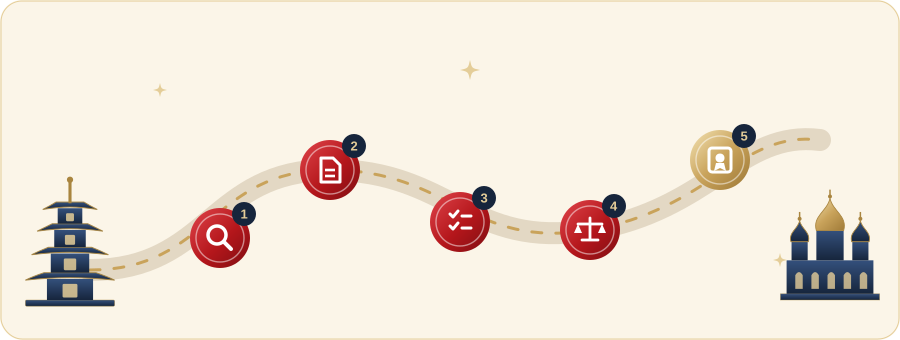
- Clearance search: up to 3 business days. Similar marks, risk assessment, Nice classes.
- Filing: up to 5 business days to prepare. The filing date becomes the priority date.
- Formal examination: about 1 month (Art. 1498). Documents and fees are checked.
- Substantive examination (Art. 1499). The mark is tested against the grounds for refusal in Art. 1483. If there are doubts, Rospatent issues an office action (examiner's notice); the applicant's arguments are taken into account if filed within 6 months of the notice (Art. 1499(3)).
- Decision and registration. After a positive decision the fee is paid, the mark is entered in the State Trademark Register and the certificate is issued.
The whole procedure usually takes 8–12 months from the filing date. It can be shortened through the paid accelerated search at FIPS (the Federal Institute of Industrial Property), to roughly 1–2 months.
4. How much it costs
The budget consists of Rospatent's official fees and the patent attorney's service fee. Payment is accepted in yuan (CNY) by international transfer; the table is in yuan.
| Cost item | 1 Nice class |
|---|---|
| Filing and formal examination fee | CNY 300 |
| Substantive examination fee | CNY 1,050 |
| Registration and electronic certificate fee | CNY 1,400 |
| Patent attorney's service fee (full service) | CNY 3,200 |
| Total | CNY 5,950 |
Each extra class adds about CNY 280 in official fees (about CNY 430 from the sixth class). See all prices and fees.
Fees also depend on the length of the list: since October 4, 2025, each item over 10 in one class costs an extra CNY 40 at examination and the same again at renewal. So it is better to keep the list short, and the list of a mark already in force can be narrowed before renewal.
Rospatent's official fees are set in rubles. They are converted to yuan here at the Bank of Russia's official rate of October 11, 2026 (RUB 12.67 per CNY 1) and rounded; the exact amount is stated in the invoice.
5. Documents you need
- The applicant's name and address, as on the business license
- An image of the mark
- A list of goods and services (the attorney assigns them to Nice classes)
- A power of attorney for the patent attorney
- For a priority claim: the number and date of the first application in China, then a copy of it (within 3 months of the filing date, Art. 1495(3))
The application is filed in Russian. Documents in a foreign language are submitted with a Russian translation (Art. 1492(6)).
6. What Chinese brands should know
Characters, pinyin, Latin letters and Cyrillic
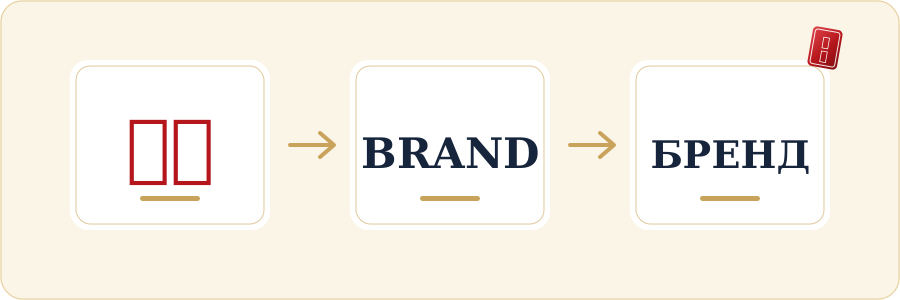
For most Russian consumers Chinese characters are a picture, not a word. If the goods are sold under a Latin-letter or Cyrillic name, protect exactly that spelling: as a separate word mark or as part of a combined one. For words in a foreign language the application states a transliteration and a translation.
What the name means in Russian
A pinyin or English name may sound awkward in Russian or coincide with a descriptive word. It is worth checking before filing.
Priority
If the Chinese application was filed no more than 6 months ago, the same priority date can be claimed in Russia (Art. 1495; Russia and China are both parties to the Paris Convention for the Protection of Industrial Property).
Who can be the applicant
A legal entity or an individual (Art. 1492(1)). The mark can be registered to a Chinese company or personally to a Chinese citizen.
National application or the Madrid system
A Chinese company can also file an international application through CNIPA under the Madrid system and designate Russia. That route requires a basic application or registration in China, and for 5 years from the international registration date the international registration depends on the Chinese basic mark. A Russian national application goes straight to Rospatent: no Chinese mark is needed, and a Cyrillic name created for the Russian market can be protected on its own.
Rospatent examines the mark on either route. If it issues a provisional refusal for a Madrid designation, a foreign holder has to reply through a Russian patent attorney (Russian Civil Code, Art. 1247(2)). I handle such replies, from CNY 1,000.
7. Common grounds for refusal
- Similarity to earlier marks for similar goods: identical or confusingly similar (Art. 1483(6)). One of the most frequent grounds, which is why a search before filing is worth it.
- Descriptiveness: the name indicates the kind, quality, properties, purpose or place of production of the goods (Art. 1483(1)).
- Lack of distinctiveness: simple geometric shapes, single letters, generally accepted symbols and terms.
- False or misleading marks: those likely to mislead consumers about the goods or their producer (Art. 1483(3)).
Most office actions can be answered: narrow the list of goods, argue that the marks are not similar or obtain a consent letter from the owner of the earlier mark.
8. After registration
- Use the mark. If it is not used for three years in a row after registration, protection may be terminated early (Art. 1486). Use by a licensee counts.
- Use the ® symbol. You may use it only after registration (Art. 1485).
- Register licenses for distributors and sellers. Without registration the grant of the right to use the mark is treated as not having taken place (Art. 1232(6)).
- Renew on time, in the last year of the 10-year term (Art. 1491).
- Keep the data current in the State Trademark Register when the company's name or address changes. Before renewal you can also narrow the list of goods. More on amendments.
Sources
- Civil Code of the Russian Federation, Part Four, Chapter 76, § 2 “Right to a Trademark and Right to a Service Mark” (Arts. 1477–1515)
- Regulation on Patent and Other Fees approved by Government Decree No. 941 of December 10, 2008 (as amended on September 23, 2025)
- Rospatent: rospatent.gov.ru; FIPS: fips.ru